Bach's Family Included Over Fifty Notable Composers and Musicians.

Introduction
Johann Sebastian Bach (31 March 1685–28 July 1750) was a German composer and musician of the Baroque period. He enriched established German styles through his skill in counterpoint, harmonic and motivic organization, and the adaptation of rhythms, forms, and textures from abroad, peculiarly from Italia and France. Bach's compositions include the Brandenburg Concertos, theGoldberg Variations, the Mass in B modest, 2 Passions, and over iii hundred cantatas of which well-nigh 2 hundred survive. His music is revered for its technical command, artistic beauty, and intellectual depth.
Bach was born in Eisenach, in the duchy of Saxe-Eisenach, into a cracking musical family. His begetter, Johann Ambrosius Bach, was the manager of the town musicians, and all of his uncles were professional musicians. His begetter probably taught him to play the violin and harpsichord, and his brother, Johann Christoph Bach, taught him the clavichord and exposed him to much gimmicky music. Plainly at his ain initiative, Bach attended St. Michael'south School in Lüneburg for two years. After graduating, he held several musical posts beyond Deutschland: he served as Kapellmeister (director of music) to Leopold, Prince of Anhalt-Köthen, Thomaskantor in Leipzig, a position of music director at the main Lutheran churches and educator at the Thomasschule, where he served from 1723 to his death. He received the title of "Imperial Court Composer" from Augustus Three in 1736. Bach'southward health and vision declined in 1749, and he died on 28 July 1750.
Bach had four composer sons. The music of 1 of them, Carl Philipp Emanuel Bach, was appreciated very highly from the later on half of the 18th through the early 19th century, while Sebastian Bach's music was hardly known.
J. S. Bach's abilities as an organist were respected throughout Europe during his lifetime, although he was not widely recognized as a great composer until a revival of interest and performances of his music in the kickoff half of the 19th century. He is at present mostly regarded every bit one of the greatest composers of all fourth dimension.
Babyhood (1685–1703)

Johann Ambrosius Bach,Bach's begetter
Johann Sebastian Bach was built-in in Eisenach, the capital of the duchy of Saxe-Eisenach, in the Thuringian region of the Holy Roman Empire, on 21 March 1685 O.S. (31 March 1685 Due north.Southward.). He was the son of Johann Ambrosius Bach, the director of the town musicians, and Maria Elisabeth Lämmerhirt.
He was the eighth child of Johann Ambrosius, (the eldest son in the family was xiv at the time of Bach'southward birth)who probably taught him violin and the basics of music theory. His uncles were all professional musicians, whose posts included church organists, court chamber musicians, and composers. I uncle, Johann Christoph Bach (1645–93), introduced him to the organ, and an older 2nd cousin, Johann Ludwig Bach (1677–1731), was a well-known composer and violinist. Bach drafted a genealogy around 1735, titled "Origin of the musical Bach family".
Bach'southward mother died in 1694, and his father died eight months later. Bach, aged x, moved in with his oldest brother, Johann Christoph Bach (1671–1721), the organist at St. Michael's Church in Ohrdruf, Saxe-Gotha-Altenburg.There he studied, performed, and copied music, including his own brother'south, despite being forbidden to practise then because scores were so valuable and private and blank ledger newspaper of that type was plush.He received valuable pedagogy from his blood brother, who instructed him on the clavichord. J.C. Bach exposed him to the works of great composers of the day, including South German composers such equally Johann Pachelbel (under whom Johann Christoph had studied) and Johann Jakob Froberger; North German composers; Frenchmen, such every bit Jean-Baptiste Lully, Louis Marchand, Marin Marais; and the Italian clavierist Girolamo Frescobaldi. Also during this time, he was taught theology, Latin, Greek, French, and Italian at the local gymnasium.

St. George'southward Church building in Eisenach, where Bach was baptized. Portal inscription: "Ein feste Burg ist unser Gott".
At the historic period of fourteen, Bach, along with his older schoolhouse friend Georg Erdmann, was awarded a choral scholarship to study at the prestigious St. Michael's School in Lüneburg in the Principality of Lüneburg. Although it is not known for certain, the trip was probable taken mostly on pes. His two years there were critical in exposing him to a wider facet of European culture. In addition to singing in the choir he played the School's three-transmission organ and harpsichords. He came into contact with sons of aristocrats from northern Deutschland sent to the highly selective school to prepare for careers in other disciplines.
While in Lüneburg, Bach had admission to St. John's Church building and possibly used the church'due south famous organ, built in 1549 past Jasper Johannsen, since information technology was played past his organ teacher Georg Böhm. Given his musical talent, Bach had significant contact with Böhm while a student in Lüneburg, and likewise took trips to nearby Hamburg where he observed "the keen North German organist Johann Adam Reincken". Stauffer reports the discovery in 2005 of the organ tablatures that Bach wrote out when still in his teens of works by Reincken and Dieterich Buxtehude, showing "a disciplined, methodical, well-trained teenager deeply committed to learning his arts and crafts".
Weimar, Arnstadt, and Mühlhausen (1703–08)
In January 1703, presently later graduating from St. Michael'due south and existence turned downwards for the post of organist at Sangerhausen, Bach was appointed court musician in the chapel of Duke Johann Ernst Iii in Weimar.His role there is unclear, but likely included menial, non-musical duties. During his seven-calendar month tenure at Weimar, his reputation as a keyboardist spread so much that he was invited to inspect the new organ, and requite the inaugural recital, at St. Boniface'southward Church in Arnstadt, located about xxx kilometers (19 mi) southwest of Weimar. In August 1703, he became the organist at St. Boniface's, with low-cal duties, a relatively generous salary, and a fine new organ tuned in the modern tempered system that allowed a wide range of keys to exist used.

St. Boniface'south Church, Arnstadt
Despite stiff family connections and a musically enthusiastic employer, tension built up between Bach and the authorities later on several years in the mail. Bach was dissatisfied with the standard of singers in the choir, while his employer was upset by his unauthorized absence from Arnstadt; Bach was gone for several months in 1705–06, to visit the bully organist and composer Dieterich Buxtehude and his Abendmusiken atSt. Mary's Church building in the northern city of Lübeck. The visit to Buxtehude involved a 450-kilometer (280 mi) journeying each manner, reportedly on pes.
In 1706, Bach was offered a postal service equally organist at St. Blasius's Church in Mühlhausen, which he took up the post-obit year. It included significantly higher remuneration, improved weather condition, and a ameliorate choir. Four months after arriving at Mühlhausen, Bach married Maria Barbara Bach, his 2nd cousin. They had 7 children, four of whom survived to adulthood, including Wilhelm Friedemann Bach and Carl Philipp Emanuel Bach who both became composers too. Bach was able to convince the church building and town government at Mühlhausen to fund an expensive renovation of the organ at St. Blasius's Church building. Bach, in turn, wrote an elaborate, festive cantata— Gott ist mein König (BWV 71)—for the inauguration of the new quango in 1708. The council paid handsomely for its publication, and information technology was a major success.

St. Mary's Church, Lübeck
Render to Weimar (1708–17)
In 1708, Bach left Mühlhausen, returning to Weimar this time equally organist and from 1714 Konzertmeister (manager of music) at the ducal court, where he had an opportunity to work with a large, well-funded contingent of professional musicians.Bach moved with his family unit into a (demolished in 1989) house, on Markt 16, very shut to the ducal palace. In the following yr, their kickoff child was born and Maria Barbara'southward elder, single sis joined them. She remained to help run the household until her death in 1729.
Bach's fourth dimension in Weimar was the start of a sustained period of composing keyboard and orchestral works. He attained the proficiency and confidence to extend the prevailing structures and to include influences from away. He learned to write dramatic openings and apply the dynamic motor rhythms and harmonic schemes constitute in the music of Italians such every bit Vivaldi, Corelli, and Torelli. Bach absorbed these stylistic aspects in office by transcribing Vivaldi's cord and wind concertos for harpsichord and organ; many of these transcribed works are still regularly performed. Bach was particularly attracted to the Italian style in which i or more than solo instruments alternate department-by-section with the full orchestra throughout a motion.

Portrait of the young Bach (disputed)
In Weimar, Bach connected to play and etch for the organ, and to perform concert music with the knuckles's ensemble.He also began to write the preludes and fugues which were later assembled into his monumental workThe Well-Tempered Clavier ( Das Wohltemperierte Klavier (BWV 846-893)—Klavier meaning clavichord or harpsichord), consisting of two books, compiled in 1722 and 1744, each containing 24 preludes and fugues in every major and corresponding pocket-sized key.
As well in Weimar Bach started work on the Picayune Organ Book, containing traditional Lutheran chorales (hymn tunes) set in complex textures. In 1713, Bach was offered a post in Halle when he brash the authorities during a renovation by Christoph Cuntzius of the main organ in the due west gallery of the Market place Church of Our Dearest Lady. Johann Kuhnau and Bach played again when it was inaugurated in 1716.
In the spring of 1714, Bach was promoted to Konzertmeister , an laurels that entailed performing a church cantata monthly in the castle church. The beginning three cantatas Bach equanimous in Weimar were Himmelskönig, sei willkommen, BWV 182, for Palm Dominicus, which coincided with the Proclamation that year, Weinen, Klagen, Sorgen, Zagen, BWV 12, for Jubilate Sunday, and Erschallet, ihr Lieder, erklinget, ihr Saiten! BWV 172 forPentecost.Bach'due south starting time Christmas cantata Christen, ätzet diesen Tag, BWV 63 was premiered in 1714 or 1715.
In 1717, Bach eventually cruel out of favor in Weimar and was, according to a translation of the court secretarial assistant's study, jailed for about a month earlier being unfavorably dismissed: "On Nov 6, [1717], the erstwhile concertmaster and organist Bach was bars to the County Approximate's place of detention for too stubbornly forcing the issue of his dismissal and finally on December ii was freed from arrest with detect of his unfavorable belch."
Köthen (1717–23)
Leopold, Prince of Anhalt-Köthen hired Bach to serve as his Kapellmeister (director of music) in 1717. Prince Leopold, himself a musician, appreciated Bach'south talents, paid him well, and gave him considerable latitude in composing and performing. The prince was Calvinist and did not utilise elaborate music in his worship; appropriately, most of Bach's piece of work from this flow was secular, including the orchestral suites, the cello suites, the sonatas and partitas for solo violin, and the Brandenburg Concertos. Bach also equanimous secular cantatas for the court such as Die Zeit, die Tag und Jahre macht, BWV 134a. A pregnant influence upon Bach's musical development during his years with the Prince is recorded by Stauffer as Bach's "complete embrace of dance music, peradventure the most important influence on his mature style other than his adoption of Vivaldi's music in Weimar".
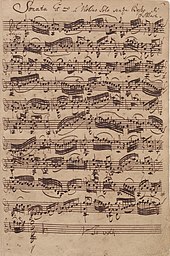
The autograph of Bach'sViolin Sonata No. i in Yard minor (BWV 1001)
Despite being born in the same year and just nearly 130 kilometers (81 mi) apart, Bach and Handel never met. In 1719, Bach made the 35-kilometer (22 mi) journey from Köthen to Halle with the intention of meeting Handel, however Handel had left the town. In 1730, Bach'south oldest son Wilhelm Friedemann travelled to Halle to invite Handel to visit the Bach family in Leipzig, but the visit did not come to pass.
On 7 July 1720, while Bach was on travel to Carlsbad with Prince Leopold, Bach's wife suddenly died. The following year, he met Anna Magdalena Wilcke, a young, highly gifted soprano seventeen years his junior, who performed at the court in Köthen; they married on 3 December 1721. Together they had 13 more children, 6 of whom survived into adulthood: Gottfried Heinrich; Elisabeth Juliane Friederica (1726–81), who married Bach's educatee Johann Christoph Altnickol; Johann Christoph Friedrich and Johann Christian, who both became significant musicians; Johanna Carolina (1737–81); and Regina Susanna (1742–1809).
Leipzig (1723–50)
In 1723, Bach was appointed Thomaskantor, Cantor of the Thomasschule at the Thomaskirche (St. Thomas Church building) in Leipzig which served four churches in the city, the Thomaskirche, the Nikolaikirche (St. Nicholas Church building), the Neue Kirche and the Peterskirche, and musical director of public functions such as metropolis council elections and homages. This was a prestigious post in the mercantile city in the Electorate of Saxony, which he held for xx-vii years until his death. It brought him into contact with the political machinations of his employer, Leipzig'south city council.
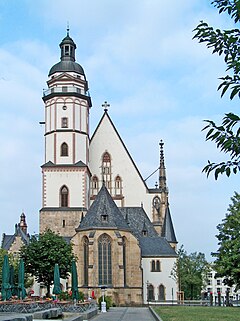
St. Thomas Church, Leipzig
Bach drew the soprano and alto choristers from the Schoolhouse, and the tenors and basses from the School and elsewhere in Leipzig. Performing at weddings and funerals provided actress income for these groups; information technology was probably for this purpose, and for in-schoolhouse training, that he wrote at least six motets. As part of his regular church building work, he performed other composers' motets, which served as formal models for his ain.
Bach's predecessor every bit Cantor, Johann Kuhnau, had likewise been music director for the Paulinerkirche, the church of Leipzig Academy. But when Bach was installed as Cantor in 1723, he was put in charge only of music for "festal" (church holiday) services at the Paulinerkirche; his petition to provide music also for regular Sunday services there (for corresponding salary increase) went all the way up to King Augustus IIbut was denied. Afterwards this, in 1725, Bach "lost interest" in working even for festal services at thePaulinerkirche and appeared there but on "special occasions". The Paulinerkirche had a much better and newer (1716) organ than did the Thomaskirche or the Nikolaikirche. Bach had been consulted officially about the 1716 organ later on its completion, came from Köthen, and submitted a report. Bach was non required to play whatever organ in his official duties, but it is believed he liked to play on the Paulinerkircheorgan "for his own pleasance".

St. Nicholas Church, Leipzig, c. 1850
Bach broadened his composing and performing beyond the liturgy past taking over, in March 1729, the directorship of the Collegium Musicum, a secular performance ensemble started by the composer Georg Philipp Telemann. This was one of the dozens of individual societies in the major German-speaking cities that was established by musically active university students; these societies had become increasingly important in public musical life and were typically led by the most prominent professionals in a city. In the words of Christoph Wolff, assuming the directorship was a shrewd move that "consolidated Bach'due south firm grip on Leipzig'south principal musical institutions". Year circular, the Leipzig's Collegium Musicum performed regularly in venues such as the Café Zimmermann, a coffeehouse on Catherine Street off the main marketplace square. Many of Bach's works during the 1730s and 1740s were written for and performed past theCollegium Musicum; amidst these were parts of his Clavier-Übung (Keyboard Practice) and many of his violin and keyboard concertos.In 1733, Bach composed a mass for the Dresden courtroom (Kyrie and Gloria) which he later on incorporated in his Mass in B minor. He presented the manuscript to the King of Poland, Grand Duke of Lithuania and Elector of Saxony, Augustus III in an eventually successful bid to persuade the monarch to give him the title of Purple Court Composer. He later on extended this work into a total mass, by adding a Credo , Sanctus and Agnus Dei , the music for which was partly based on his own cantatas, partly new equanimous. Bach's appointment as court composer was function of his long-term struggle to achieve greater bargaining power with the Leipzig council.
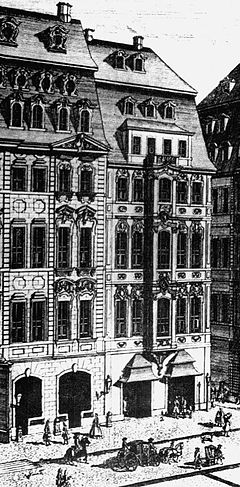
Café Zimmermann, Leipzig, where the Collegium Musicum performed
In 1735 Bach's youngest son Johann Christian Bach was born. In childhood he "enjoyed his father'southward particular affection" and had "precocious talents." He grew up to get a composer, simply in a galant style rather than his male parent's baroque style. In 1762 he travelled to England, gained repute there, and became music main to Queen Charlotte.
Between 1737 and 1739, Bach's former pupil Carl Gotthelf Gerlach took over the directorship of theCollegium Musicum.
In 1747, Bach visited the court of King Frederick II at Potsdam. The king played a theme for Bach and challenged him to improvise a fugue based on his theme. Bach improvised a three-part fugue on one of Frederick's fortepianos, then a novelty, and subsequently presented the king with a Musical Offering which consists of fugues, canons and a trio based on this theme. Its six-role fugue includes a slightly altered subject more than suitable for extensive elaboration.
In the same yr, Bach joined the Corresponding Society of the Musical Sciences ( Correspondierende Societät der musikalischen Wissenschafften ) of Lorenz Christoph Mizler. On the occasion of his entry into the Club, Bach equanimous the Canonic Variations on "Vom Himmel hoch da komm' ich her" (BWV 769). A portrait had to be submitted by each member of the Order, so in 1746, during the preparation of Bach'southward entry, the famous Bach-portrait was painted by Elias Gottlob Haussmann. The Canon triplex á 6 Voc (BWV 1076) on this portrait was dedicated to the Society. Other tardily works by Bach may also take a connection with the music theory based Lodge. One of those works was The Art of Fugue, which consists of xviii complex fugues and canons based on a uncomplicated theme. The Fine art of the Fugue was only published posthumously in 1751.
Bach's last large piece of work was the Mass in B minor (1748–49) which Stauffer describes as "Bach'due south most universal church piece of work. Consisting mainly of recycled movements from cantatas written over a 30-v year flow, it allowed Bach to survey his song pieces ane last time and selection select movements for farther revision and refinement."Although the complete mass was never performed during the composer's lifetime, it is considered to be among the greatest choral works of all time.
Expiry (1750)

Bach's grave, St. Thomas Church, Leipzig
Bach'southward health declined in 1749; on 2 June, Heinrich von Brühl wrote to 1 of the Leipzig burgomasters to request that his music managing director, Johann Gottlob Harrer, fill the Thomaskantor and Director musices posts "upon the eventual … decease of Mr. Bach".Bach was becoming bullheaded, and then the British eye surgeon John Taylor operated on Bach while visiting Leipzig in March or April 1750.
On 28 July 1750, Bach died at the historic period of 65. A gimmicky newspaper reported "the unhappy consequences of the very unsuccessful eye functioning" every bit the cause of death. Spitta gives some details. He says that Bach died of "occlusion", a stroke. He, along with the newspaper, says that "Medical treatment associated with the [failed eye] functioning had such bad effects that his health … was severely shaken" and Bach was left totally blind. His son Carl Philipp Emanuel and his pupil Johann Friedrich Agricola wrote an obituary of Bach. In 1754, it was published by Lorenz Christoph Mizler in the musical periodical Musikalische Bibliothek . This obituary arguably remains "the richest and about trustworthy"early on source document about Bach.
Bach'south estate included five harpsichords, two lute-harpsichords, three violins, three violas, two cellos, a viola da gamba, a lute and a spinet, and 50-2 "sacred books", including books past Martin Luther and Josephus. He was originally buried at Quondam St. John's Cemetery in Leipzig. His grave went unmarked for about 150 years. In 1894, his remains were located and moved to a vault in St. John's Church. This building was destroyed by Allied bombing during World State of war II, so in 1950 Bach's remains were taken to their nowadays grave in St. Thomas Church. Afterwards research has called into question whether the remains in the grave are actually those of Bach.
Legacy
Afterward his expiry, Bach'due south reputation as a composer at first declined; his work was regarded as old-fashioned compared to the emerging galant manner.Initially he was remembered more equally a virtuoso player of the organ and every bit a teacher.
Many of Bach's unpublished manuscripts were distributed amidst his wife and musician sons at the time of his decease. Unfortunately, the poor financial condition of some of the family members led to the sale and subsequent loss of parts of Bach'south compositions, including over ane hundred cantatas and his St Mark Passion, of which no copies are known to survive.
During the late 18th and early on 19th century, Bach was recognized by several prominent composers for his keyboard work. Wolfgang Amadeus Mozart,Ludwig van Beethoven, Frédéric Chopin, Robert Schumann, and Felix Mendelssohn were amongst his admirers; they began writing in a more contrapuntal style after beingness exposed to Bach'due south music. Beethoven described him as " Urvater der Harmonie ", the "original begetter of harmony".

Statue of Bach, Leipzig
Bach'south reputation amidst the wider public was enhanced in part by Johann Nikolaus Forkel's 1802 biography of the composer. Felix Mendelssohn significantly contributed to the renewed interest in Bach's work with his 1829 Berlin performance of the St Matthew Passion. In 1850, the Bach-Gesellschaft (Bach Society) was founded to promote the works; in 1899 the Social club published a comprehensive edition of the composer's works with picayune editorial intervention.
During the 20th century, the process of recognizing the musical as well every bit the pedagogic value of some of the works continued, maybe most notably in the promotion of the cello suites by Pablo Casals, the first major performer to tape these suites. Some other evolution has been the growth of the historically informed performance movement, which attempts to take into account the artful criteria and performance do of the period in which the music was conceived. Examples include the playing of keyboard works on harpsichord rather than modern grand pianoforte and the use of small choirs or single voices instead of the larger forces favored by 19th- and early 20th-century performers.
The liturgical calendar of the Episcopal Church remembers Bach annually with a feast twenty-four hours on 28 July, together with George Frideric Handel and Henry Purcell; the Calendar of Saints of the Lutheran Church, on the same mean solar day remembers Bach and Handel with Heinrich Schütz. In other circles, Bach'southward music is bracketed with the literature of William Shakespeare and the science of Isaac Newton.
During the 20th century, many streets in Germany were named and statues were erected in laurels of Bach. A big crater in the Bach quadrangle on Mercury is named in Bach'south honor every bit are the master-belt asteroids 1814 Bach and 1482 Sebastiana. Bach'southward music features iii times—more than than that of any other composer—on the Voyager Golden Tape, a gramophone record containing a broad sample of the images, mutual sounds, languages, and music of Earth, sent into outer space with the two Voyager probes.
lynchferoffaces1939.blogspot.com
Source: https://courses.lumenlearning.com/musicappreciation_with_theory/chapter/j-s-bach-his-life-and-legacy/
0 Response to "Bach's Family Included Over Fifty Notable Composers and Musicians."
Post a Comment