Powerless Black Person in the Arts Image Classical Music
A s the globe clustered, transfixed, around television set screens, watching and rewatching footage of a plane gliding into the top of New York'southward twin towers and a tiny, anonymous man plummeting to earth, another scene was unfolding on the ground, as panic-stricken families stumbled through the smoke and rubble to get together up their children from schools and kindergartens.
Fine art Spiegelman and Françoise Mouly stood four blocks away with their daughter, watching the second tower autumn "in excruciatingly deadening motion". Equally art manager of the New Yorker magazine, Mouly knew that she would accept to come with a rapid response. "I felt that images were suddenly powerless to help united states of america understand what had happened. The only appropriate solution seemed to be to publish no cover image at all – an all-black cover. Then Art suggested adding the outlines of the two towers, black on black. So from no embrace came a perfect prototype, which conveyed something almost the unbearable loss of life, the sudden absence in our skyline, the sharp tear in the cloth of reality," she later recalled.
"It was the advent of the second airplane, sharking in low over the Statue of Liberty: that was the defining moment…" wrote Martin Amis in the Guardian. "I have never seen a generically familiar object so transformed by consequence… That 2d plane looked eagerly alive, and galvanised with malice, and wholly conflicting. For those thousands in the south tower, the second plane meant the cease of everything. For us, its glint was the worldflash of a coming time to come."
Journalism might be the rough draft of history, merely from the offset authors, artists and particularly novelists were called upon to do the drafting. And from the showtime they started jostling with each other. In that early slice, Amis sneered at the "wooden words" of thriller writer Tom Clancy; past the fifth ceremony of the assail, he would himself be publicly excoriated by his Manchester University colleague Terry Eagleton, for his writing on Muslim extremism.
Comedians, still, were warned to go along their mouths shut. After Bill Maher, host of the late-night talkshow Politically Incorrect, attacked the emerging rhetoric of the catastrophe, the prove lost advertising and was axed. His offense was to betoken out, with the acuity of good political one-act, that lobbing missiles from 2,000 miles away, as the US had been doing for years with its "surgical strikes", was cowardly, while staying on a airplane as information technology hits a building was non.

Comedian Pete Davidson was seven years onetime when his firefighter male parent died in the rescue functioning. He would keep to test the pieties surrounding the event by working the experience into his routines (and cartoon boundary-stretching "roastings" from his peers). Merely it took a long fourth dimension for standups to find their mojo once more. Contributors to Too Soon: Comedy After 9/11, 1 of the many TV documentaries that volition mark adjacent week's 20th anniversary, retrieve Saturday Night Live tentatively reintroducing the possibility of jokes ten days subsequently the attacks, with a spoof news report that the mafia had stolen more than 250 tonnes of fleck metal from lower Manhattan: "Well," they said, "the mayor told us to go dorsum to work."
There's a sense in which, in the west at to the lowest degree, much of the art created since that momentous day exists in its shadow and fifty-fifty that which pre-existed it has been recreated by it. "Out of the south windows the Trade towers stood cut against the night, intensely massed and well-nigh. This is the discussion 'loomed' in all its prolonged and impending strength," wrote Don DeLillo, in what is arguably his great nine/11 novel, not 2007's Falling Man, but 1991's Mao Two. "What does it fifty-fifty mean: the 20th anniversary? It seems to assume that things began on that day," says the Pakistani novelist Mohsin Hamid. "I think that ahistorical approach resulted in the disaster we're seeing in Kabul now."
On 6 November 2001, a Telly drama that had been in production long earlier the day itself made its showtime appearance. Set over a unmarried crisis-packed solar day, 24 starred Kiefer Sutherland every bit counter-terrorism agent Jack Bauer, whose othering of Muslims and pragmatic approach to torture would become a reference indicate for debate around U.s. foreign policy over nine series and 204 episodes. In 2007, Bill Clinton himself cited Bauer in a clumsily revealing TV interview, saying: "I call up what our policy ought to be is to be uncompromisingly opposed to terror – I mean to torture, and that if you're the Jack Bauer person, you'll do whatever you do and you should be prepared to take the consequences, and I recall the consequences volition be imposed based on what turns out to be the truth."
Spiegelman was among those whose initial shock curdled into rage at the misappropriation of the tragedy for political and economic ends. In 2004, he created a moving-picture show book based on his blackness towers cover, In the Shadow of No Towers, which depicted how the post-9/11 world had broken the "the states" into red and blueish zones. "It seems axiomatic to me that the best response to a work of art is some other work of art," he said. His book duly became the inspiration for a symphony past the Arab-American composer Mohammed Fairouz, who challenged the thought (reinforced past many of the rock world'south early attempts to generate songs about the attacks) that musicians should steer well articulate of politics. Fairouz subverted the patriotism of marching bands and trumpet solos with a wind ensemble that, by the third motion, was split into two distinct groups, reflecting the ideological chasm in Spiegelman's book. "The cartoonish results, which approach cacophony, echo the brazen visual form of the graphic novel," noted the Wall Street Journal.

Past the middle of the 00s, motion picture was first to procedure the experience, with the sort of variable results that are revealed by two releases from 2006. Both took their viewers back to the day itself. In the red corner was Oliver Stone, whose basis-ready World Trade Center was criticised by Observer critic Philip French for simultaneously celebrating and exploiting love, family life and communal endeavor "in the fashion of a second world war propaganda amusement".
In the blue corner was Paul Greengrass, whose United 93 was largely set aboard one of the hijacked planes. Greengrass's background was in documentaries and he made use of its techniques to convey the horrifying happenstance of the mean solar day. A jittery photographic camera on fly-on-the-wall duty observes fuel pumping into the aircraft'south tanks, a human being running on to the plane just equally the doors are closing, a girl applying lip gloss, while an elderly woman gets out her knitting needles (which, of course, would never be permitted on planes again). It was, wrote French, "gripping from offset to last, partly because, like a Greek tragedy, we are only likewise aware of where everything is heading and partly because nosotros are simultaneously taken back to that day that shook the world".
The moving picture'south climax, with some passengers desperately phoning home as others steel themselves to tackle the hijackers and divert the plane, recalled one of the most resonant literary-journalistic aperçus of the immediate aftermath. "There is but love, so oblivion," wrote the novelist Ian McEwan in the Guardian. "Love was all they had to set up against the hatred of their murderers." Only by the mid 00s, the generation of white, liberal and predominantly male person writers to which McEwan belonged were starting to await hawkish in their post- nine/11 certainties.
McEwan'south novel Saturday centred on the march against the Iraq state of war in London in 2003, for which 2 million people are estimated to have turned out. Published in 2005, it told the story of a surgeon whose leisurely solar day of playing squash, cooking and making honey to his wife is inconvenienced by the marchers. The initial critical consensus that it was another masterpiece was shattered past a review by the Irish novelist John Banville in the New York Review of Books. "Sat has the feel of a neoliberal polemic gone badly wrong," he wrote. "If Tony Blair – who makes a fleeting personal appearance in the book, oozing insincerity – were to appoint a committee to produce a 'novel for our time', the result would surely exist something similar this."

Sixteen years on, the combination of the novel itself and its adulatory reception seem to me to corporeality to a monument of sorts, providing an uncomfortably acute film of the complacency, the collusion of high civilisation and low politics, which has landed us in the sorry state we're in today. Banville, nonetheless, resists such reappraisal. "Despite popular misconceptions – and much hostage but extremely bad work – art cannot give an immediate response to gimmicky events," he says. "Information technology's merely non equipped for that. And when artists endeavour, they fail. Picasso's Guernica is kitsch, as he came to realise himself in later years."
2 years afterwards Saturday, Mohsin Hamid signalled the emergence of a new – and more than internationalist – literary generation with his second novel, The Reluctant Fundamentalist. He had written a "terrible" first draft, before 9/11, about a young Pakistani homo working in corporate New York who, after a failed love affair, grows a bristles and moves back to Lahore. "A few weeks afterward, the terrorist attacks of September 11 happened. My globe inverse. I wrote the novel once again. And again," he has written. His achievement was to make a sympathetic character of Changez, a Muslim bookish firebrand whose ideological grooming basis turns out to have been Princeton and Wall Street, and whose objectionable views extend to beingness "remarkably pleased" past 9/11. In a sense, as one critic wrote, Changez "is the embodiment of the argument that says that America has created its own enemies".
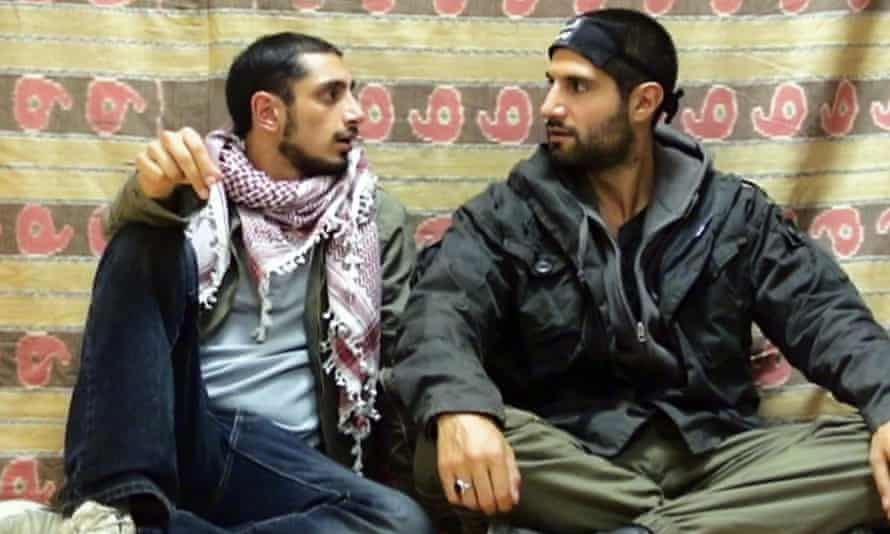
The chief virtue of Mira Nair'due south 2012 film adaptation of The Reluctant Fundamentalist was the casting of the actor and rapper Riz Ahmed as Changez. Ahmed's film career had begun in Michael Winterbottom's 2006 docudrama The Road to Guant ánamo, as one of the "Tipton Iii", a trio of young British Muslims from the West Midlands who took on the U.s.a. legal organisation after being captured in Transitional islamic state of afghanistan and then imprisoned and tortured in Guantánamo Bay. This was film calling power to account, every bit theatre had also begun to do with the emergence of verbatim plays. Pioneered at n London's Tricycle theatre by the author/director team of Richard Norton-Taylor and Nicolas Kent, these dramatised in scrupulous detail the miscarriages of justice occasioned past the west's hunger for revenge.

On his way back from filming The Road to Guant ánamo, Wembley-built-in Ahmed was detained at Luton airport by community officers who, he would later write in the bestselling anthology The Adept Immigrant, "frogmarched me to an unmarked room where they insulted, threatened and then attacked me". He wrote a song about the experience, Post 9/11 Blues: "We're all suspects so picket your back/ I farted and got arrested for a chemical set on."
The vocal drew him to the attention of the cultural disruptor Chris Morris, who put both Ahmed and his lyrics into his 2010 debut film, Four Lions, an edgy satire nearly a quartet of hapless terrorists from the Westward Midlands who manage to evade the equally hapless security forces, despite joining the London marathon dressed up as chickens and bears. At its Sundance premiere, the Hollywood Reporter described the film as "a brilliant takedown of the imbecility of fanaticism", neglecting to mention the sinister mirroring that ends upwardly with a agglomeration of Keystone anti-terrorist cops seizing the devout and peace-loving blood brother of Ahmed's character, Omar.
In his Good Immigrant memoir, Ahmed usefully divided life as a post 9/eleven actor of minority heritage into 3: stage i, he wrote, is the ii-dimensional stereotype – the minicab driver/terrorist/corner shop possessor. Phase two is the subversive portrayal, taking place on "ethnic" terrain but aiming to challenge existing stereotypes. Stage three is the Promised Land, where he might even be allowed to play a character named Dave. This gradual admission into the order of "us" has played out in many areas of post-nine/11 culture.
In her 2017 novel Habitation Fire, which won the Women'south prize for fiction, Kamila Shamsie wrangled the Greek myth of Antigone with recent political history. It featured a British Muslim home secretarial assistant a year before Sajid Javid landed the job. "Burnt Shadows [her 2009 novel] is more plain influenced by 9/11 in then far as it starts and ends with a human being in Guantánamo," she says. "Simply yes – other than [home secretary] Karamat Lone – everyone else in Home Fire grows upward in a world that is living the consequences of the state of war on terror. I wanted to look at what it meant for that generation of British Muslims to grow up knowing no other world except the i that existed post 9/11. My firsthand interest was to look at how attitudes of Islamophobia and racist laws (citizen stripping) shape people'southward lives – all that goes back to 2001."
She was pleasantly surprised by the response. "I expected a cracking many more voices to say I sympathised with terrorists, but what I found instead was people wanting to understand man stories behind headlines. There was an interesting duality in the British responses – a number of British Muslims said, thanks for telling stories that resonate so much with our lives, whereas a number of non-Muslim Brits said, thank you for telling these stories; nosotros had no idea these kinds of lives went on in the country in which we're living."

Two decades afterward the attacks, the twin towers are memorialised on what came to be known as Footing Zero by ii square pools of water surrounded by 400 swamp white oak trees, following a Daniel Libeskind pattern, as elaborated past the Israeli-American architect Michael Arad. A wedge-shaped glazed pavilion shelters an underground memorial museum that movingly incorporates twisted relics from the original towers.
Only many of the people afflicted by the devastating long tail of the attacks don't take the luxury of a permanent place of contemplation and pilgrimage. On 11 September 2021, a 12-human foot-tall puppet, representing a nine-year-quondam Syrian refugee, will walk into Rome to be greeted past buildings lit up with projected paintings of her ruined homeland. The installation, by exiled Syrian artist Tammam Azzam, is merely one of 100 community "welcomes" for Little Amal forth an 8,000km route, thousands of miles from the site of the original strikes, not a centimetre of which hasn't been touched by its fallout. Little Amal's journey bookends the intervening period with possibly the virtually indelible line in that very first journalistic response from Martin Amis, before the bombast set it: "The nigh durable legacy has to do with the more distant future, and the disappearance of an illusion near our loved ones, especially our children," he wrote. "The illusion is this. Mothers and fathers need to feel that they tin can protect their children. They can't."
lynchferoffaces1939.blogspot.com
Source: https://www.theguardian.com/us-news/2021/sep/05/how-the-arts-responded-to-911
0 Response to "Powerless Black Person in the Arts Image Classical Music"
Post a Comment